I've been on both sides of this. I've sent aluminum parts to shops in Ohio, shipped drawings to Shenzhen, and spent too many hours comparing quotes that looked nothing alike. I don't have a grand theory about global manufacturing. What I have is a list of things I got wrong and a few things I eventually got right.
If you're sourcing aluminum CNC machining and wondering whether a Chinese shop is worth the hassle, here's what I actually see day to day.
The cost difference is real, but not where most people think
People fixate on the hourly rate. "$15/hour in China vs $80/hour in the US." That's not wrong, but it misses the actual story.
For a simple aluminum bracket — 6061-T6, qty 100, no tight tolerances — I recently got quotes from three US shops and three Chinese shops.
| Cost item | US Shop A | US Shop B | China Shop A | China Shop B |
|---|---|---|---|---|
| Unit price (machined) | $34.50 | $38.00 | $12.80 | $14.20 |
| Setup/tooling | $0 (amortized) | $250 | $80 | $0 (waived) |
| Surface finish (Type II anodize) | $4.20/part | $3.80/part | $1.50/part | $1.80/part |
| Shipping (air, to Chicago) | $0 | $0 | $3.20/part | $2.80/part |
| Total per part | $38.70 | $42.30 | $17.50 | $18.80 |
The Chinese shops came in at 55% less. But here's the part people miss: the gap shrinks dramatically when you factor in three things.
One, shipping isn't free and it isn't fast. Air freight door-to-door from Shenzhen to Chicago runs about $4-6/kg. For a 100-part order of small aluminum brackets, that's roughly $3 per part. Ocean freight is cheaper — about $0.40 per part for the same batch — but it takes 25-35 days instead of 5-7. If your parts are heavy or bulky relative to their value, shipping eats the savings.
Two, communication overhead has a real hourly cost. You're going to spend more time on email, more time on WeChat, more time clarifying things that would be obvious to a domestic shop that shares your timezone and engineering culture. Some of my customers spend zero extra time. Others spend 10+ hours managing a single order. The ones who spend zero extra time are the ones who sent a clean drawing with clear notes and no ambiguity from day one.
Three, rework and quality issues happen on both sides, but the resolution cost is different. If a US shop machines 100 parts and 3 are out of spec, you get replacements in 3 days at their cost. If a Chinese shop machines 100 parts and 3 are out of spec, they'll also replace them — but the replacements take 10 days (air) or you wait for the next batch. The shop is responsible, but your project timeline doesn't care who's at fault.
Material — this is where China shines for aluminum
Aluminum is aluminum, right? Sort of.
China produces more aluminum than the rest of the world combined — about 41 million metric tons in 2025 according to the International Aluminum Institute. That scale means something practical: raw 6061-T6 plate and bar stock in standard sizes are significantly cheaper in China than in the US or Europe.
For 7075-T6, the gap is even wider. Chinese aerospace-grade 7075 has improved substantially in the last decade. Ten years ago I wouldn't touch it for anything load-bearing. Now? We routinely machine 7075 parts from domestic Chinese stock that pass first-article inspection with the same mechanical properties as material from Kaiser or Alcoa. The certification paper trail isn't as clean as what you'd get from a Western mill, so if you need full material certs with traceability back to the pour, specify that upfront and expect to pay a premium for it. Most shops will provide it, but it costs extra and adds a few days.
One thing I've learned: Chinese shops keep a lot of standard aluminum stock on the shelf. 6061-T6 in common thicknesses (6mm, 10mm, 12mm, 16mm, 20mm, 25mm) is almost always available same-day. 7075-T6 in common sizes, usually next-day. Exotic alloys like 2024 or 7050 — you need to ask. Some shops have relationships with mills and can get it quickly. Others will quote you a lead time that assumes they start sourcing after you pay.
Equipment — the capability gap has closed
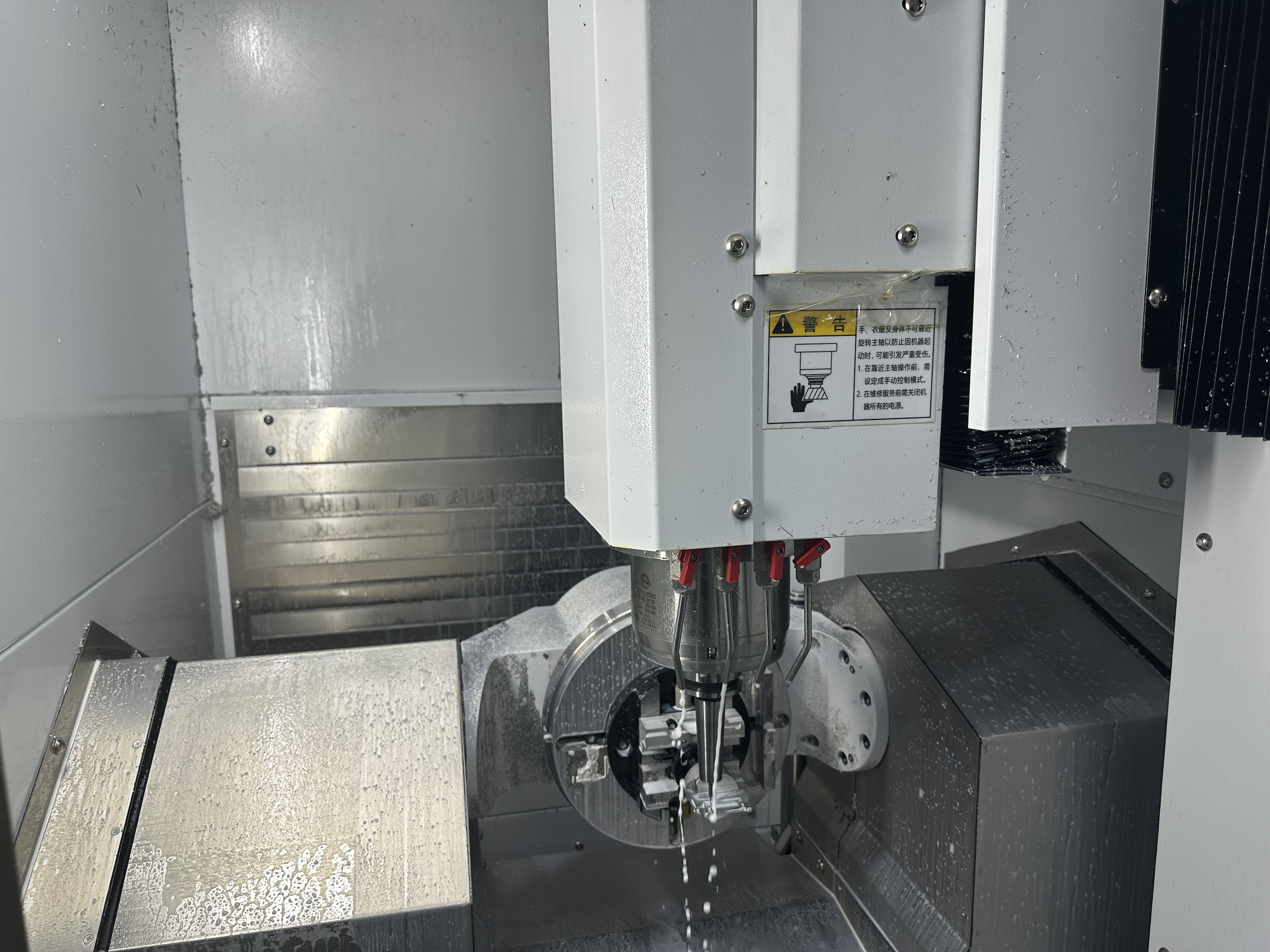
This is uncomfortable for some people to hear, but the best Chinese CNC shops run the same machines as the best US shops. DMG Mori 5-axis machines. Brother Speedio drill-tap centers. Star Swiss-type lathes. Zeiss CMMs. The equipment floor at a top-tier Shenzhen or Dongguan shop looks indistinguishable from a top-tier shop in Illinois.
The difference is not the machines. It's the process control around the machines.
A good Chinese shop will run first-article inspection on a CMM, provide a dimensional report in PDF, and maintain SPC data if you ask for it. A not-good Chinese shop will do a visual check with calipers and ship the parts. The same is true in any country. The harder part is that when the shop is 7,000 miles away, you can't drop in on a Tuesday afternoon to audit their process.
This is why the real question isn't "are Chinese shops good?" — it's "how do I find a good one?" More on that in a minute.
The 5-axis capability in China deserves its own mention. Five years ago, 5-axis capacity in China was concentrated in aerospace and mold making. Now it's broadly available for general commercial work. Shops are buying 5-axis machines specifically to reduce setup count and improve accuracy on complex aluminum parts — housings, manifolds, brackets with compound angles, parts that used to need three or four setups on a 3-axis mill. The economics work because 5-axis reduces labor (fewer setups, less fixturing) and labor is still the advantage.
Communication — this is the bottleneck
Every sourcing problem I've seen between a Western buyer and a Chinese CNC shop traces back to one thing: the drawing wasn't clear enough.
Here's the pattern. A US engineer sends a drawing to a US shop. The drawing says "break all sharp edges." The US shop knows that means a 0.010-0.020 inch chamfer or radius unless otherwise specified. They do it. Nobody discusses it.
Same drawing goes to a Chinese shop. "Break all sharp edges" gets translated. The shop may interpret it literally — a light deburring pass, 0.1-0.2mm radius. The parts arrive with edges that are broken but still sharper than the customer expected. Customer is unhappy. Shop is confused because they did exactly what the drawing said.
The fix is not to find a shop that reads minds. The fix is to specify what you mean. "Break all sharp edges — 0.25mm radius minimum on all external edges." That sentence costs three seconds to add and saves a week of back-and-forth.
Other things I always specify now when sending aluminum parts to a Chinese shop:
- Surface finish callout with an Ra value, not words like "smooth" or "clean"
- Anodize spec with exact type, color, and masking requirements
- Thread inspection method (go/no-go gauge vs full thread measurement)
- What counts as a cosmetic defect vs a functional defect
- Packaging requirements — especially for anodized parts that scratch easily
Every minute you spend on the drawing before sending saves roughly ten minutes of clarification later. I learned this the hard way.
Logistics — plan for the timeline, not the best case
If a Chinese shop quotes 10 days for machining and 5 days for air freight, here's what actually happens:
The 10 days machining becomes 12 because the anodizing subcontractor ran behind. Then there's a 3-day gap between "parts are ready" and "parts are picked up by the forwarder." Then the 5-day air freight becomes 7 because customs in LA is backed up. Your 15-day total becomes 22 days.
This isn't because Chinese shops are dishonest. It's because every link in the chain has a best-case and a typical-case, and the quotes add up all the best-cases. I now budget 7-10 days of buffer on top of whatever timeline the shop quotes. If the parts arrive early, great. They almost never do.
For aluminum parts that need anodizing, add another 3-5 days. Anodizing is almost always done at a separate facility. The parts get machined, cleaned, sent to the anodizer, anodized, inspected, returned to the machine shop, final-inspected, packed, and shipped. Each handoff adds a day or two.
When I would NOT send aluminum parts to China
- You need them in under 3 weeks. Air freight from China to the US or Europe takes 5-8 business days door-to-door. Add machining time (typically 7-14 days for a standard aluminum job) and you're at 3 weeks minimum. If you need parts faster, machine locally.
- The order is under $1,000 total. The shipping, customs brokerage, and communication overhead become disproportionate. I generally only offshore jobs above roughly $2,000 in total value.
- You don't have a clean drawing. If your "drawing" is a napkin sketch with some dimensions and a prayer, machine locally. A US shop will call you and ask questions in your timezone. A Chinese shop may just make what they think you want.
- Your tolerance requirements are genuinely extreme. ±0.01mm on every feature, GD&T callouts that require CMM programming from a detailed inspection plan, surface finish requirements below Ra 0.4 μm — these are doable in China, but the shops that can reliably hit them charge prices not far from US rates. The advantage narrows.
- ITAR or export-controlled parts. This one is black and white. Don't. Not worth it.
The framework I use to decide
| Factor | Favor Chinese shop | Favor domestic shop |
|---|---|---|
| Part material | Aluminum (especially 6061/7075) | Exotic alloys, special certifications |
| Quantity | 100+ parts | Under 50 parts |
| Tolerance | ±0.05mm or looser | ±0.01mm or tighter |
| Timeline | 4+ weeks | Under 3 weeks |
| Drawing quality | Fully defined, GD&T where needed | Still in development |
| Surface treatment | Standard anodize, alodine | Special processes, tight color matching |
| Part complexity | Medium complexity, 3-5 axis | Requires frequent design iteration |
| Budget sensitivity | High — cost is a top priority | Cost is secondary to speed or convenience |
If you check "Chinese shop" on at least five of those eight factors, the economics probably work.
How I evaluate a Chinese CNC shop from 7,000 miles away
You can't walk the floor, but you can ask questions that separate the real shops from the trading companies.
A trading company is an office with a website that takes your drawing, marks it up 20-30%, and sends it to an actual machine shop. They handle the communication but add cost and remove accountability. Nothing wrong with them per se, but you should know who you're dealing with.
Questions I ask:
"Can you send me photos of the actual machines that will run my parts?" A real shop sends photos in 10 minutes. A trading company sends stock photos or stalls.
"What CMM do you use and can you include a dimensional report with the first shipment?" The answer should be a specific brand and model — Zeiss Contura, Hexagon Global, Mitutoyo Crysta. If they say "we have inspection equipment" without naming it, that tells you something.
"What's your anodizing process — in-house or outsourced? Who's the anodizer?" They should know exactly which facility does their anodizing and have a relationship with them. "We have a partner" is fine. "We'll figure it out" is not.
"Can you send me photos of three similar aluminum parts you've made recently, with the customer name blurred?" Real shops have recent work to show. If they can't produce photos of actual aluminum parts they've machined, they're probably not machining them.
"What's your scrap rate on aluminum parts and how do you handle out-of-spec parts?" There's no right answer to the scrap rate number, but there's a wrong answer: "we don't have scrap." Every shop has scrap. A shop that admits it has a process for managing it. A shop that denies it is lying about something.
Send a simple test part first. Something small and representative that costs $200-500. See how the communication goes. See the quality. See the packaging. The test order is the cheapest due diligence you'll ever do.
What this means for your next RFQ
If you're sourcing aluminum CNC machined parts and your domestic quotes are eating your margin, send the drawing to a few Chinese shops. Not as a replacement for your current supplier — as a benchmark. See where the quote lands. Ask the five questions above. Judge the response time and communication quality.
You might find that the Chinese quote is 40% less but the communication was terrible and the timeline was vague. That's useful information. You might find a shop that was 55% less with excellent communication, recent aluminum part photos in the first email, and a timeline they actually committed to in writing. That's also useful.
Our shop in China specializes in aluminum CNC machining for export. 6061, 7075, 5052, 2024 — we stock all four. Five-axis capability. In-house CMM inspection with reports on every order. We send photos of your parts before they ship so there are no surprises. And we'll give you a dimensional report you can actually use.
If you want a quote, send your drawing to our contact page. If you want a straight answer about whether your part makes sense to machine in China, I'll give you one — even if the answer is "machine this one locally."
FAQ: Aluminum CNC machining
What's the minimum order quantity for aluminum CNC machining from China?
There isn't a universal minimum. Some shops won't touch anything under 50 pieces. Others — including us — will run 1 to 10,000+. At low quantities (1-10 pcs), the per-part price is higher because setup costs don't amortize, but the total cost is still often lower than domestic shops. I've seen single aluminum prototypes from China come in at half the US price even after air shipping.
Which aluminum alloys are best for CNC machining?
6061-T6 is the workhorse. Good strength-to-weight, excellent machinability, welds well, anodizes beautifully. Most aluminum parts should be 6061 unless you have a reason not to.
7075-T6 if you need strength approaching mild steel — common in aerospace, bicycle components, and high-stress brackets. Harder to machine than 6061, more expensive, poor corrosion resistance, can't be welded, and anodizes with a slightly yellowish tint.
2024 for fatigue-critical aerospace parts. 5052 for sheet metal bending and marine environments. 7050 for thick aerospace sections. 6063 for architectural extrusions.
How tight can aluminum tolerances be when machined in China?
±0.05mm (about 0.002") is routine on any competent shop with decent equipment. ±0.025mm (0.001") is achievable on critical features with good process control — we hit this daily. Below ±0.01mm, you're into grinding or EDM territory, the price climbs steeply, and you need to be very selective about which shop you use. For reference, the thermal expansion of aluminum 6061 is about 23 μm per meter per degree C — so a 5°C temperature swing moves a 100mm feature by roughly 0.01mm. At some point you're fighting physics, not the machine.
What surface finishes are available for machined aluminum parts from China?
As-machined (Ra 0.8-1.6 μm), bead blasting (uniform matte, Ra 1.0-2.0 μm), anodizing Type II (clear, black, or custom colors — 5-25 μm thickness), anodizing Type III hardcoat (25-100 μm, high wear resistance), alodine/chem-film (corrosion protection, conductive), powder coating (wide color range, durable), brushing, polishing (mirror finish possible), and laser engraving for part marking. Anodizing and powder coating are typically done at subcontractor facilities. Ask who does it and how they control quality.
How do I avoid quality issues when ordering aluminum CNC parts from China?
Send a drawing that leaves nothing to interpretation. Specify tolerances on every critical dimension — don't rely on a generic title block tolerance for features that matter. Include surface finish requirements with Ra values. Specify anodize type, color, and masking areas. Request a first-article inspection report with measured values for all critical dimensions. Ask for photos of the parts before they ship. Start with a small test order before committing to production quantities. And never select a shop on price alone — the cheapest quote is almost always the most expensive in the long run.